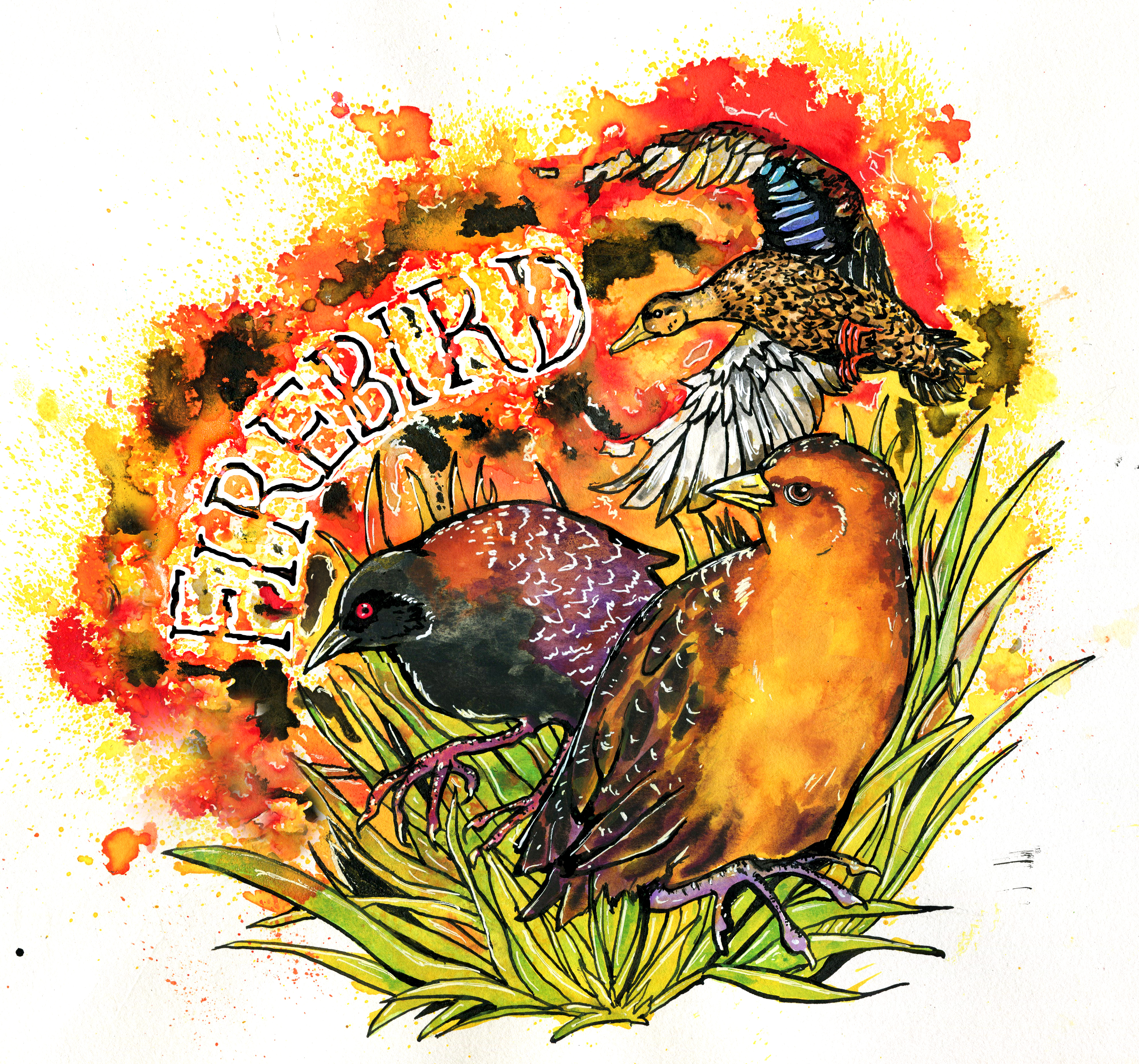
Hear about all of the research being done by the Firebird team and interact with us during an open discussion.
Zoom Details:
https://illinois.zoom.us/j/86510683289?pwd=cEhJcHdHTFVtSkFXdTBNbmt3QnJnZz0
Meeting ID: 865 1068 3289
Password: 021880
Hear about all of the research being done by the Firebird team and interact with us during an open discussion.
Zoom Details:
https://illinois.zoom.us/j/86510683289?pwd=cEhJcHdHTFVtSkFXdTBNbmt3QnJnZz0
Meeting ID: 865 1068 3289
Password: 021880
A cool new video and blog on the Firebird research in Florida was featured on the WFSU public media Ecology Blog. Heather Levy, a biologist with Tall Timbers, did a great job representing team Firebird! Check out the video below and go to the link to read the blog post!
Check out the newest issue of our newsletter providing updates from the winter 2022-2023 field season and other cool things!
A new paper from the Firebird Climate Team titled, “Preferred atmospheric circulations associated with favorable prescribed burns in the Gulf of Mexico, U.S.A.” has been published in Fire Ecology. In 2021, Cao et al. published a new method and weather classification system for the Gulf of Mexico, an important climate tool to be used for improving habitat management in the Southeast U.S.A. In a follow up study led by Chelsea Kross, the Firebird Climate Team asked two questions: “Has weather circulation pattern frequency changed over time in the northern Gulf of Mexico?” and “Do prescribed fire applicators show preference or avoidance of specific weather circulation patterns across the northern Gulf?”.
With the the listing of the Black Rail (Laterallus jamaicensis) to the USFWS ESA threatened list (USFWS 2021), the authors wanted to specifically answer these questions to improve habitat management along the Gulf Coast. While historical fire patterns along the Gulf Coast likely occurred from late-spring to early-fall, climate change and species conservation initiative (i.e. increased marsh bird breeding) have likely increased the need for applying fire during the Fall and Winter months. As such, the authors focused data collection to examine weather circulation frequencies and prescribed fire application during the non-growing season (Oct-March).

To address the first question, the authors gathered weather data from 1979 to 2018 and classified two time periods a day (1200 and 1800h) into one of eight potential weather types. Interestingly, the frequency of each weather type had not changed over time.

To address the second question, the authors gathered federal prescribed fire application data from 1985 to 2018 and compared the proportion of weather types when prescribed fire was applied to the proportion of weather types during the burning time period. The western Gulf (i.e. Texas) showed stronger preference or avoidance of weather types compared to the eastern Gulf (i.e. Florida). However across the northern Gulf of Mexico prescribed fire was preferentially applied during circulations with strong offshore wind flows.

Prescribed fire application has and is expected to become more challenging due to a combination of climate change (Kupfer et al. 2020), however our results suggest that weather circulation pattern frequency has changed dramatically over time. This indicates that other factors, such as urban development growth along the Gulf Coast or changes in public health policies, could have a stronger influence than availability of suitable weather conditions on prescribed fire application. Another possibility is that while weather frequency has not changed over time, the length of suitable weather conditions (i.e. the burn window) could have changed (Rohli and Henderson 1997). These are all possibilities that need further, more fine-scale, analysis.
The observed patterns in preference and avoidance of specific weather types make sense when considered across the Gulf and provide some support for other factors having a strong influence on prescribed fire application. For example, most states along the Gulf of Mexico showed a preference for weather circulations with offshore wind flows. Pushing wind off shore during a prescribed fire event can be important for smoke transport and limiting smoke pollution in urban areas and meeting local, regional, or state air pollution guidelines.
While weather is a vital component of prescribed fire practice, the strong preference for weather circulations that promote offshore wind flow across the Gulf of Mexico suggests other factors (i.e., smoke transport) might have a more weighty influence on prescribed fire application.
Chelsea Kross, Illinois Natural History Survey
ckross@illinois.edu
Kross, CS, RV Rohli, JA Moon, AMV Fournier, MS Woodrey, and JA Nyman. Preferred atmospheric circulations associated with favorable prescribed burns in the Gulf of Mexico coast, U.S.A. Fire Ecology https://doi.org/10.1186/s42408-023-00169-4
Cao, W, RV Rohli, F Han, AJ Vega, N Bushra, and JA Nyman. 2021. Atmospheric circulation regimes for prescribed burns along the US Gulf of Mexico coast. Applied Geography 136 (2021): Art. No. 102587. https://doi.org/10.1016/j.apgeog.2021.102587
A new paper from the Firebird High Marsh Mapping Team titled, “Elevation-based probabilistic mapping of irregularly flooded wetlands along the northern Gulf of Mexico coast” has been published in Remote Sensing of Environment. The primary objective of this study was to develop probabilistic maps for irregularly flooded wetlands along the northern Gulf of Mexico. While this work can address many needs, the key motivation for this effort was to produce a product that could be used to later develop a map of high marsh and salt pannes, which are found within the irregularly flooded wetland zone. The approach used coastal wetlands from existing land use/land cover data, best available lidar-derived digital elevation models, and Monte Carlo simulations to incorporate elevation uncertainty.

The output of this study was a probabilistic raster that was published as a USGS data release (Enwright et al., 2022). To quantify and explore differences in areal coverage along the northern Gulf of Mexico, the probability values in the map were classified into three equal bins (probability ≤0.33; probability >0.33 and ≤ 0.66; and probability >0.66). Wetlands in the lowest probability class (i.e., “unlikely”) were labelled as being in the upper (higher) or lower portion of the irregularly flooded wetland zone. This map product can serve many important applications including providing a baseline for gauging future coastal wetland transformation with climate change, mapping high marsh and salt pannes, and designing wetland vegetation and faunal monitoring programs.

The framework developed in this study was used to produce an elevation-based probabilistic map of irregularly flooded wetlands. This product can be helpful for highlighting regional variability, teasing out high marsh and salt pannes, and tracking changes in the future due to sea-level rise.
Corresponding Author and Link to the Article
Nicholas Enwright, U.S. Geological Survey, Wetland and Aquatic Research Center, enwrightn@usgs.gov
https://doi.org/10.1016/j.rse.2023.113451
Literature Cited
Enwright, NM, WC Cheney, KO Evans, HR Thurman, MS Woodrey, AMV Fournier, DB Gesch, JL Pitchford, JM Stoker, and SC Medeiros. 2023. Elevation-based probabilistic mapping of irregularly flooded wetlands along the northern Gulf of Mexico coast. Remote Sensing of Environment, 287, 113451.
Enwright, NM, WC Cheney, K Evans, HR Thurman, MS Woodrey, AMV Fournier, A Bauer, J Cox, S Goehring, H Hill, K Hondrick, P Kappes, H Levy, J Moon, JA Nyman, J Pitchford, D Storey, M Sukiennik, and J Wilson. 2022. Mapping irregularly flooded wetlands, high marsh, and salt pannes/flats along the northern Gulf of Mexico coast: U.S. Geological Survey data release, https://doi.org/10.5066/P9MLO26U.
NOAA. 2016. NOAA’s Coastal Change Analysis Program (C-CAP) 2016 Regional Land Cover Change Data – Coastal United States [dataset]. https://coast.noaa.gov/htdata/raster1/landcover/bulkdownload/30m_lc/CCAP_Parent_2016.xml.
Sweet, WV, G Dusek, J Obeysekera, and JJ Marra. 2018. Patterns and Projections of High Tide Flooding Along the U.S. Coastline Using a Common Impact Threshold. NOAA Technical Report NOS CO-OPS 086. https://tidesandcurrents.noaa.gov/publications/techrpt86_PaP_of_HTFlooding.pdf.
Our first project newsletter covering up thorugh our Summer 2022 work can be downloaded here.
We’d like to extend an invitation for our adaptive management virtual workshop and request that you reserve the following dates on your calendar: 19-22 October.
If you work with any of our focal species (Mottled Duck, Black Rail, Yellow Rail), in high marshes in the Gulf of Mexico, and/or with prescribed fire, you’re input would be extremely valuable.
Tuesday, 19 Oct: AM and PM sessions
Wednesday, 20 Oct: AM and PM sessions
Thursday, 21 Oct: AM and PM sessions
Friday, 22 Oct: AM session only
We will send along a detailed agenda for the workshop soon. Please use the following link to register: https://forms.office.com/g/bxMy59TTmi
Thank you! We are looking forward to another productive and engaging workshop! If you have any questions, please feel free to email Michelle Stantial (mstantial@usgs.gov) or Jim Lyons (jelyons@usgs.gov).
We are getting ready for the 2021 field season, where we will be testing out rail detection methods, performing high marsh habitat assessments, and figuring out what questions we will focus on based on our adaptive management workshop. We have already added some job announcements to our job postings page and will be adding more for field crews and graduate students over the next few months. So keep an eye on the job postings if you are interested in being involved!
The Team: Auriel M.V. Fournier (lead investigator, University of Illinois Urbana-Champaign, auriel@illinois.edu), Mark Woodrey (lead investigator, Mississippi State University), Kristine Evans (Mississippi State University), John Andrew Nyman (Louisiana State University Agricultural Center), Robert Rohli (Louisiana State University), Warren Conway (Texas Tech University), Michelle Meyers (United States Geological Survey), Jim Lyons (United States Geological Survey), Robert Cooper (University of Georgia), Erik Johnson (National Audubon Society), Jim Cox (Tall Timbers Research Station), and Chris Butler (University of Central Oklahoma)
Collaborators: William Vermillion (Gulf Coast Joint Venture/US Fish and Wildlife Service), Joe Lancaster (Gulf Coast Joint Venture/Ducks Unlimited), Michael Brasher (Ducks Unlimited), Amy Schwarzer (Florida Fish and Wildlife Conservation Commission), Ron Bielefeld (Florida Fish and Wildlife Conservation Commission), Eric Soehren (AL Department of Conservation and Natural Resources), Jennifer Wilson (US Fish and Wildlife Service), Jena Moon (US Fish and Wildlife Service)
Technical Monitor: To be determined
Federal Program Office/ Point of Contact: Frank Parker (frank.parker@noaa.gov)
Research Area: Multispecies, weather and climate
Award Amount: $3,922,699
Award Period: This project began in September 2019 and will end in August 2024.
Why we care: Black rail and yellow rail are identified as birds of conservation concern (migrating nongame birds that are likely candidates for Endangered Species Act listing without additional conservation actions). Mottled ducks are of high conservation concern as the only species of duck which spends its entire year along the Gulf Coast. Natural resource managers are tasked with conserving all three bird species, yet we know very little about their response to fire in high marsh wetlands. This lack of understanding limits natural resource managers’ ability to manage and conserve the biodiversity of the Gulf Coast. This project will address specific information needs of resource managers and conservation organizations like determining the distribution and habitat use of yellow rails, black rails, and mottled ducks during breeding and nonbreeding seasons, and understanding how prescribed fire practices influence that distribution and abundance in high marsh habitats.
What we are doing: This project monitors black rail, yellow rail, and mottled duck responses to prescribed fire application using an adaptive management framework. The framework will inform decision-making by helping researchers and resource managers test predictions and improve our understanding of how these birds of concern interact with high marsh ecosystems and prescribed fire. Specifically, this project will:
Expected Outcome: This project will create computer models of co-occurrence, distribution, and abundance of black rail, yellow rail, and mottled duck. This project will also identify potential trade-offs or synergies from prescribed fire applications in high marsh ecosystems. This information will reduce uncertainty around the response of high priority bird species to prescribed fire and aid future management decisions.

 NOAAFireBird